Movie Review - “The Boy in the Plastic Bubble”
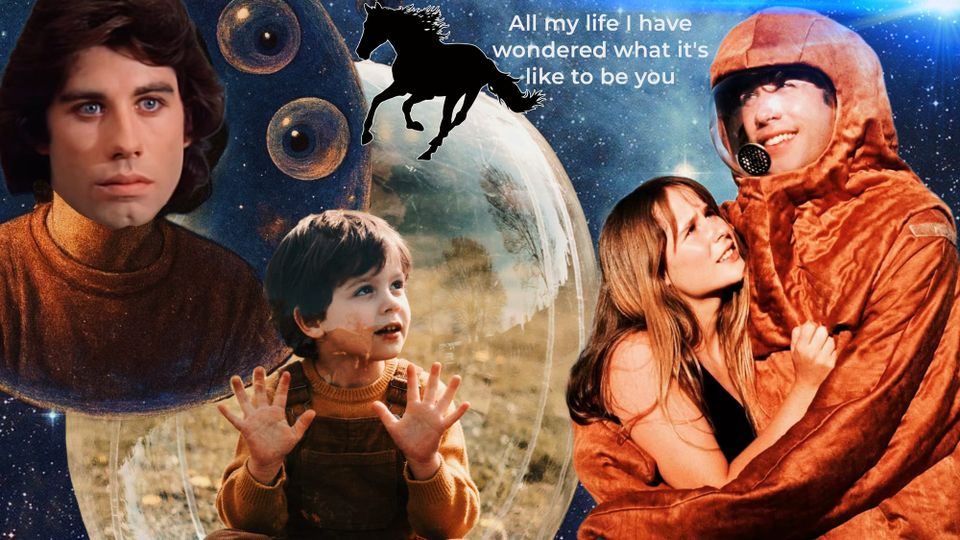
There is something deeply moving and disturbing about spending an entire life physically separated from your family and loved ones. Is it ethical to allow a child to grow up in a protective bubble that keeps him from getting sick, while knowing the isolation he faces creates anguish? Does the boy have any say in his life and treatment? Can a story be told about the boy that includes a fabricated happy ending, even if one didn’t exist in real life? There are few more stranger stories than the one I watched last night…
When a couple at home in their garden receive a visit from their doctor, and learn they are pregnant, a happy scene quickly becomes a tragic affair. The mother, played by Diana Hyland, who posthumously won an Emmy Award for her role, becomes distraught because she lost an earlier baby and is afraid it could happen again with this new pregnancy. She fears the consequences of making a decision to have a child that could be sick, and the impact that this would have on the child’s future. Her husband tries to console her with a probabilistic approach. “There’s only a one in four chance it could happen again.” And then mentions, “There’s never been two people more meant to be parents than you and me, God knows that.” This is the opening scene to the 1976 made for tv movie, “The boy in the plastic bubble.” A film inspired by the true-life story of David Vetter, a boy born without a functioning immune system in 1971.
David Vetter was already famous at this point for having the rare condition, known as SCID (severe combined immune deficiency). News media had followed him his entire life and because he was both a patient and a research subject, he effectively became a “living experiment”. Trapped and constantly monitored inside a plastic enclosure, there to keep him free from germs circulating in the air, he was a child who would never feel his parents touch, except through plastic gloves. In the movie, when the couple have their baby, the boy is quickly transferred into a plastic container, and the parents are told by doctors that until their son develops an immunity or science develops a cure he will have to stay in his protective bubble. This is followed by a heartbreaking moment where the mother apologises to her baby and her husband tears up, as she tries to hold her son through the plastic enclosure.
The film continues to show the emotional impact of having a child with an illness and how much the parents are focused on watching over and protecting him. A scene shows the four-year-old child being brought home from the hospital to live with the parents, and the news media teams scrambling to get photos of the boy, causing the father to demand they leave him alone, and announcing, ‘my son is not a freak.’ Later, the parents panic when their child is suffocating. They frantically try to fix the air pump for the enclosure, which they think is malfunctioning only to realise their son has accidentally swallowed a button from his teddy bear and is choking.
Soon after this the movie jumps forward in time and John Travolta makes his appearance as a 17-year-old version of the boy still trapped in the plastic bubble, waiting for his body to build up natural immunity. This film is one of John Travolta’s first major starring roles on television, just before Saturday Night Fever and Grease catapulted him to film star status. Travolta plays the role with sensitivity. He also captures the stirring teenage frustrations well, built from being isolated and kept away from the outdoors, sports, and teenage friendships. After being surrounded by adults all his life, he spends hours watching the girl next door as she rides her horse and hangs out with her friends by the lakeside. Despite this, Travolta’s character is surprisingly upbeat, and this means the audience never pities him and instead grows fond of him.
One of my favourite scenes in the film is when Travolta’s character goes to school in a spacesuit like outfit, and wants to impress Gina, the girl next door, by challenging one of her male friends to a round of press ups, to see who is the strongest. Travolta wins, but in the process uses up all his oxygen. His friends help race him back to the classroom where he just manages to enter the sterilised oxygen chamber and avoids suffocating to death. However, this scene was far from scientifically accurate, and David Vetter, who saw the film from his plastic bubble, reportedly questioned how unrealistic it was for Travolta's character to use a makeshift spacesuit and re-enter the sterile bubble without bringing in contaminants. This highlights a gap between David’s lived reality and the film’s dramatization.
Ultimately the film was not about depicting the real life of David Vetter, but rather functioned as a metaphor for loneliness, isolation, being “different,” wanting connection and the wish to belong. Any teenager who has ever felt “isolated, picked on, or odd” would likely identify with Travolta’s character—placing the film squarely in the youth drama category. In 1976 it was a big ratings success and generally seen by TV critics as an engaging “disease of the week” melodrama and a teen romance, rather than a serious medical drama. The ending was ambiguous and romantic. Critics would argue the film implies that love and courage can override years of infection control, as Travolta’s character eventually chooses to leave the bubble for love’s sake, effectively facing a very short future. The filmmakers however wanted an emotionally satisfying, metaphorical “break free” climax that fit a teen romance, even if it meant sacrificing medical realism and clear closure. Ending on the horseback ride set to Paul Williams’s song gives viewers a feeling of liberation and hope, which is exactly what a 1976 prime time audience would be conditioned to expect—even if, as modern reviewers note, “you’re convinced Tod is going to die at any minute.”
The real-life case of David Vetter was vastly different from the television movie. He only lived until he was 12 years old. He never overcame the illness he suffered from because treatment was limited at the time. But researchers who used blood and cell samples preserved from David and other boys with X‑linked SCID, identified in the early 1990s the mutation and specific gene responsible for X‑SCID. That discovery helped move SCID diagnosis from “a baby who keeps getting sick” to precise genetic and immunologic testing, and eventually to population‑wide newborn screening. David’s greatest legacy was in medicine. Because of what was learned from his case, many SCID‑affected infants today are identified within days of birth and can receive curative bone marrow transplants before life‑threatening infections appear.
The film did not delve into ethical dilemmas such as whether it is justifiable to keep a child in a sterile environment for years, how to balance research against the child’s own interests, and how to handle experimental interventions. By focusing on romance and individual courage, the film diverted attention from questions around physician responsibility, institutional accountability, and long‑term planning for worst‑case scenarios, such as what if no cure arrives, and what if the experiment harms the child? The real David Vetter may have found the fictional version of his life hard to watch. Because in the film his character finds love and a way to escape his prison. The TV film appropriates his story while giving David virtually no narrative say. The real boy was alive when the movie aired; he was watching a fictionalised version of his own life, broadcast to millions, without having chosen that symbolic role. This raises questions of: Who gets to represent medically vulnerable children in the public sphere? How much do parents and physicians “own” a child’s story? Do media makers have duties to involve or at least consult the subjects whose lives they mine?
Despite the film’s lack of medical realism, much of the dialogue and situational drama is really heartfelt. When Travolta’s character almost kills himself trying to impress Gina by doing press ups, it’s because he wants to show ‘he’s not a cripple and some weirdo kid’ who people feel sorry for. He just wants to be a man, someone who Gina will care about. And one of the most memorable lines in the film is when both Travolta’s character and Gina confess, ‘All my life I have wondered what it’s like to be you.’ The film is hopeful, painful and sincere. It was made at a time when filmmakers still preferred emotion over spectacle. It is a time capsule that is worth seeing. Fans of Travolta will enjoy it, as will people interested in 1970s TV history. As a snapshot of 1970s television, The Boy in the Plastic Bubble might resonate even more so with today’s youth through a mix of relatable themes (isolation, difference, first love), cult retro TV, and pandemic‑era resonance.