Atomic Times
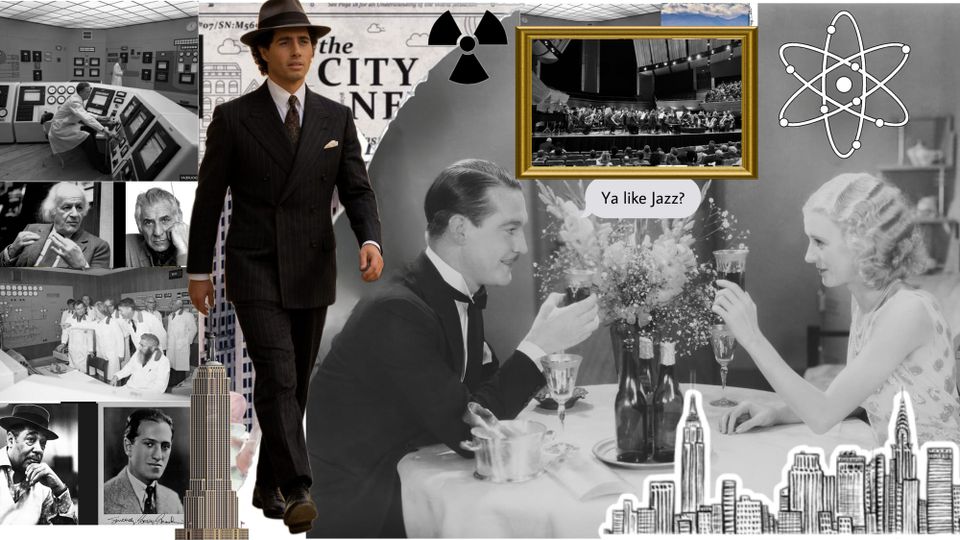
The 2026 season of Orchestra Wellington is underway at the moment, and I went along to their first show on Saturday 30th May 2026. I was joined by my father; Geoff, and a good long-time friend of his; John. The night began with a rendition of Leonard Bernstein’s ‘Chichester Psalms’, composed by Bernstein in 1965.
Bernstein was not only famous for his music, but for his activism. He supported the civil rights movement in America as it challenged racial segregation and discrimination, he protested the Vietnam War, advocated for nuclear disarmament, raised money for HIV/AIDs research and engaged in world peace initiatives. Because he grew up through the Great Depression, the rise of Nazism, the Second World War, and the advent of nuclear weapons, he wanted to infuse his artistic works with faith, peace and human brotherhood. After President John F. Kennedy’s assassination, he famously declared, “This will be our reply to violence: to make music more intensely, more beautifully, more devotedly than ever before,” a line he and others returned to after later tragedies.
Later that evening, I asked my father; Geoff, who was born in 1955 in Wellington NZ, if the music brought back memories of his youth. He said, “Very much so. Chichester Psalms with its unusual rhythms, sudden intensity and then radiant calm reminded me of lost innocence, in a way, and growing up. In NZ, things were often comfortably about rugby, racing and beer. But at the same time new music, fashion and politics including international news of civil rights struggles and student movements were shaking things up. There’s this feeling of society being safe, but under the surface things get muddied because of global culture and political currents.”
This first performance of the night also resonated with my father’s friend, John, who said, “The early 1960’s was a prosperous time for NZ with new music filling our ears from the Beatles, Rolling Stones and Pink Floyd. But by the late 1960’s the profitable wool boom ended, and the Vietnam war began. Young people did not agree with the ‘domino theory’ used by the Americans to justify the war. The protests to the Vietnam war divided the country and seemed to end the prosperity. The music of Chichester Psalms, reminded me of the tension we faced growing up, and the peace we made with it eventually as we matured.”
The concert continued with George Gerswhin’s ‘Piano Concerto in F’ written in 1925. The music had an urban spirit about it, and it was easy to imagine the pulse and variety of New York streets during the Roaring Twenties. After a short interlude, we heard the music of Rolf Liebermann and his 1954 ‘Concerto for Jazz Band and Orchestra’.
Rolf Liebermann was a Swiss composer who used mathematical twelve-tone techniques to create his music. Though most of his avant-garde peers used the technique as a direct psychological and political reaction to WWII, the Holocaust and dawn of the atomic bomb, Liebermann wanted to create fun dance music with it. In his 1954 piece, the movements are explicitly named after popular upbeat dance styles of the era: jump, blues, mambo and boogie-woogie to make his music fun. While his peers chose to treat musical composition like a clinical laboratory experiment, stripping emotion out of art, Liebermann’s wish was to create light-hearted dance music using the same technique. His music was widely celebrated for its rhythmic energy, wit, and accessibility, delighting audiences from Europe to the United States.
My dad Geoff, and his long-time friend John, both appreciated this ‘atomic age’ of music. They told me, “The 1950’s and 60’s was a time when NZ’s protection and wellbeing lay with its larger friend, the US, who promised to keep NZ safe under its nuclear umbrella. In a way we were proud to be part of a protected western bloc, but at the same time, it was scary to think that our survival depended on weapons capable of ending civilisation.”
Geoff’s friend John, told me he had first learnt about nuclear power while studying at Canterbury University in the early 1970’s. I asked John why he chose to study electrical engineering and how this led him onto nuclear energy studies. This was his reply.
“So what made me interested in studying electrical engineering? Well, my father got me into it. My father was surveyor for an electricity authority. He was in the Second World War, and couldn’t go to university. He wanted me to go to university and get a degree. And I said, well, what should I do? And he said, well, do electrical engineering because he was an electrical engineer. So I did engineering because he couldn't do that himself, and he was very proud of me for doing that.
In our last year of study, we did learn a bit about the theory of the atom and nuclear physics as part of the degree. We didn't really study nuclear engineering or nuclear power very much, but we certainly got to understand the theory of fission and fusion, that kind of thing. For our honours degrees, if we were chosen to do honours, we were able to do a project of some sort. Most of my friends in electrical engineering had chosen to do telecommunications. That was the snazzy thing back then. But I deliberately chose to do power systems. Besides I wanted to get a scholarship to England.
Now, yes, there was indeed a subcritical reactor, but it was only a student teaching tool. It just had radioactive sources in it, which we used to irradiate things. Like you could inject radioactive traces into the human body and track it. This was done before the days of MRIs. It was done with very low doses of radioactivity.
So here was this not quite big reactor. It was, oh, twice the size of a typical dining room table. And when you looked down into it, it was full of water, purified water, deionized water, I think, and then demineralized. The water slows down the radioactive particles that are emitted from uranium-238. And so you look down to this thing, you could see these radioactive things in there. I thought it was cool. And that's the only reason I did it. I was not studying nuclear power. I actually built a radiation monitor because I just thought it was quite exciting.”
For those who do not know, the sub-critical research reactor was a gift from the United States under President Eisenhower’s Atoms for Peace program. It operated for 20 years at the University of Canterbury from 1961 to 1981 at which point it was closed down and dismantled. It did not generate electricity through a nuclear chain reaction as would a normal power reactor. It simply worked as a teaching tool, showing NZ engineering students what nuclear physics looked like in practice without the risks and costs of a full power reactor.
The last composer we heard music from on the night was that of Duke Ellington, and his 1950 piece, Harlem. As I sat listening to this last display of jazz and symphonic harmonies, the very loud sounds of the full symphony orchestra hit me with its sonic waves. I really wanted to know more about John’s experiences, so after the concert was over, I asked John, if he had ever worked in a functional nuclear power plant. This was his reply.
“When I finished my master's degree, I did have an apprenticeship. It was called a graduate apprenticeship, but it was at A Reyrolle in Newcastle on Tyne (northeast England). It went for 2 years. There, I did all the normal stuff that an apprentice does and observed how switchgear was being made and how electric fault protection was worked out.
I joined all of the British students who were doing their apprenticeships, but I was given a scholarship to do it from New Zealand. We had to go out to a real power station where switches were actually being used and protection was being used. I was assigned to go to the large new Prototype Fast Breeder reactor (PFR) in the summer of 1973 as a very young student, at Dounreay. And so that meant driving from Newcastle on Tyne all the way to the very top of Scotland.
The reactor had not been loaded with uranium and plutonium when I worked in the power station. That took place in 1974, and the reactor started working in 1975 to generate electricity for the grid. So no radioactivity was present when I worked there. However, I did visit the earlier research reactor - Dounreay Fast Reactor (DFR). This was the original experimental reactor—famous for its large, distinctive steel sphere or "golf ball" dome, because I wanted to. It was nearby and working, so was radioactive. I wore a dosimeter while in the building, which showed I received no radiation. The reactor produced plutonium, which would be used in the new PFR next door. Hopes were high, that fast breeders would be the way of the future.
So the PFR was soon going to become a working reactor. While I was there, I performed commissioning of the electrical components that protected the plant. In other words, what I mean by protection is if something goes wrong, like a fuel rod doesn't drop in properly or there's a lightning strike or whatever, then the electrical protection automatically turns off the reactor. So that's the electronics that I was working on.
So the fact that I built a radiation monitor was relevant, actually. The Dounreay PFR was on its way to becoming a working reactor so security was very tight. The security was to do with the fact that liquid sodium was used as the coolant in fast breeder reactors. Liquid sodium is extremely reactive; it will ignite spontaneously upon contact with oxygen. It will also react violently with water, so water or air leaks can completely disable a facility and create severe cascading hazards. Another reason for the security, was that fast breeder reactors pack their fuel elements much tighter than standard light-water reactors. Liquid sodium is used because it transfers immense heat away from this dense core extremely fast. If a security breach or sabotage compromised the sodium pumps or punctured the cooling lines, the reactor could lose its ability to remove heat almost instantly. Without the sodium flow, the tightly packed core would experience an uncontrolled temperature spike, leading to a rapid nuclear core meltdown.
Fast breeder reactors like Dounreay got their name from using fast neutrons and ‘breeding’ fuel. They operated at a much higher temperature, and used fast neutrons rather than what's called thermal neutrons (standard reactors). Standard reactors intentionally slow neutrons down, while fast breeder reactors deliberately keep them moving at their original, high-speed velocities. While a fast breeder reactor could theoretically start with U-235, their core design relied on Plutonium-239 (239PU) as the primary fuel. Fast neutrons are highly inefficient at splitting U-235. But they are incredibly efficient at splitting Plutonium-239. The defining feature of a breeder reactor was that it produced more fuel than it burnt. To achieve this, the neutron math looked completely different to a standard reactor. In a standard reactor exactly one neutron splits the next atom to keep the reaction steady. The other neutrons are absorbed by control rods or lost. In a Fast Breeder Reactor: for every atom (239Pu) that splits, more than two released neutrons are actively put to work: Exactly one neutron is allowed to split another Plutonium atom to keep the electricity-generating chain reaction steady. More than one remaining neutron (usually 1.2 to 1.5 on average) is allowed to strike the surrounding Uranium-238 blanket to convert it into new Plutonium. If exactly one neutron were allowed to interact and the rest were thrown away or blocked, the reactor could maintain power, but it would completely fail to "breed" any new fuel. So the fact that it could ‘breed’ new fuel, made me believe that fast breeder reactors were the way of the future. To me this was amazing.
New Zealand had by then, made the decision not to build nuclear power plants. It was only because of my own personal interest that I got very interested in fast breeder reactors. I was only there for a month or two.
My time at Hunterston B (another nuclear power plant) which was located in North Ayrshire, Scotland, United Kingdom was longer, and it was what's called an advanced gas-cooled reactor. So it was cooled by liquid CO2 and it operated at a lower temperature. It was less thermally efficient than a fast breeder, which operated at a much higher temperature. We were building the electrical protection, which we had made back on Tyneside back in Hebburn, and it was being installed at Hunterston B. I did ask and did get permission to go inside the reactor vessel itself before it had been loaded with uranium fuel. So it was an awe-inspiring experience to go into this enormous reactor.
It was as big as a church. If you imagine a church such as Wellington Central Baptist Church, the diameter was nearly as big as the church was long. It was huge! If you've seen the photographs of the Chernobyl Reactor, it's about the same size. It's big. And you look up, and you can see these standpipes, all of these holes and up there where the control rods would be inserted. And that made a huge impression on me. This engineering was just so mind boggling. The problem with advanced gas cooled reactors was that pumping the CO2 caused vibration in the reactor vessel, and the insulation sort of shook down like when you wear a wet sock. And they had to redesign them. And it held it up for years and added a lot to the cost. CO2 is a very dense gas when it's highly pressurized, and it sends shock waves all through the insulation. So the advanced gas cooled reactors became very expensive in England, and at about that same time, they decided not to build anymore. Today Britain is building new European Pressurised Reactors (EPRs) using water.
What was a typical day like, working in a nuclear power plant? At Hunterston B, it was installing panels of generator protection, which were fabricated in Hebburn. We'd have to drill holes in concrete, put them in, do all the wiring behind them, test that they were working, and simulate faults. I had nothing to do with the nuclear fuel cycle.
How did people react when I told them I was learning about nuclear power? I was working with blue collar guys, and they don't really care. To be honest, they were earning money by installing this protection. They don't care whether it was nuclear power or gas power or coal power. Was there lots of security? Certainly, yes. There was lots of security in Dounreay because of the real danger of sodium leaks.
What was different about the two nuclear reactors? Utterly completely different, and I've explained a little bit, haven't I? The Prototype Fast Breeder Reactor (PFR) at Dounreay involved: fast neutrons, high temperatures, liquid sodium coolant, real plutonium fuel, you had to be careful of water leaks and so on. The PFR plant ceased power generation in 1994. It was decided it was just too expensive, and using the highly volatile liquid sodium proved to be an engineering nightmare. Even minor pipe faults led to highly complex repairs. Today, robotic tools are being used to remove radioactive materials jammed inside the old reactor cores, and highly volatile sodium residues are still being carefully neutralized. Because of the extreme hazards left behind by the experimental fuel, current UK Nuclear Decommissioning Authority strategies predict it will take until at least 2070 to 2078 to completely clean, demolish, and clear the site.
In the case of Hunterston B it operated satisfactorily for nearly 46 years before being permanently shut down in January 2022.”
I asked John if he had any other experiences with nuclear powered reactors. This is keeping in mind that NZ is nuclear free and has never used nuclear power generation or allowed nuclear powered ships or nuclear weapons into its ports. This was his reply.
“In around 1992, I was in a team that visited various places in Europe, particularly Norway, to study how electric markets worked on the basis of spot prices. We mainly went into the headquarters of the power companies and the market group in Norway. As part of that, they offered to take us to a decommissioned power station called Rjukan and this was the place where heavy water used to be made. It had become a museum (Norwegian Industrial Workers Museum). Heavy water is used as a moderator in some nuclear power stations and needs a lot of electricity to make.
You make heavy water by distilling rain water to get out the deuterium oxide, which is called heavy water. Normal water is hydrogen oxide, but deuterium oxide is D2O. D2O is put into nuclear reactors as a moderator and a coolant to slow down the neutrons. Deuterium heavy water reactors are still used in Canada to this day and do not use enriched uranium. For your information, Canada's domestic nuclear reactors rely entirely on its homegrown CANDU (CANada Deuterium Uranium) reactor technology. Because CANDU reactors use deuterium oxide (heavy water) as their moderator, they possess a near-perfect "neutron economy." Normal light-water reactors swallow too many neutrons, forcing them to use expensive enriched Uranium (3% to 5% U-235) to keep a reaction going. CANDU reactors are so efficient at preserving neutrons that they run completely on natural, unenriched uranium—exactly as it is mined out of the ground in Saskatchewan
So we went to the Norwegian Industrial Workers Museum. Now the thing was that back in 1945, they were making heavy water for the Germans. Germans were trying to build nuclear bombs around the end of World War II. So the British commandos went and bombed this power station and put out of action the heavy water plant. It was repaired. Later the sad part of the story was this. The Norwegians put the heavy water into barrels and onto a ferry which was crossing the fiords. The Norwegian secret service knew this was going to happen. So they decided, believe it or not, to blow up, and sink this ferry, to stop the heavy water getting to Germany. Now there were Norwegians on the ferry who all died at the hands of their own military because they were blowing up the heavy water, and the heavy water went to the bottom of the fiord, very deep.
So the team I was in visited the Norwegian Industrial Workers Museum. Towards the end of the visit, the manager of the museum said to me, would you like to see the heavy water? And I said, yes. And he said, alright. You come with me. I can't take everybody. Okay, so down we went to the power station down, down, and into a locked room. Here were barrels, one undamaged full of heavy water, which had been there since the second World War. Wow. I couldn't believe it. I was seeing history. Now some of them had gotten blown up, the barrels were broken, and so the heavy water had escaped. But one of the barrels with heavy water was still there.”
I asked John if the visit to various places in Europe as part of studying how electricity markets worked over there, allowed him to see anything else of interest. This was his reply.
“We visited Sweden which was part of this visit that I have been telling you about. It was essentially a New Zealand government mission to Scandinavia to study their electricity systems and to see how their power stations were dispatched. How did the market work? How did these power stations bid their supply into the market so that the power stations would be scheduled optimally. As part of the visit they took us to see one of their nuclear power stations. This power station was called Oskarshamn 3. I was absolutely amazed by this place. It was a 1,050 megawatt power station. It was big!
I could hardly see anybody there. Just two or three men in the control room. It was clean, scrupulously clean. You could eat your breakfast off the floor, literally. The control room was spotless. Everything just was under complete control. And I could not imagine a disaster occurring there because it's Swedish engineering, which uses ASEA, Brown Boveri the best companies in the world.
The manager of the power station said to me, would you like to see the spent fuel? And I said, yes. I'd love to. So we got in an electric powered bus, and went down, down underground beneath the power station, well under sea level, and we saw what appeared to be like a big swimming pool. Again, scrupulously clean with this eerie blue light coming out of the spent fuel rods, under the water. And the blue light, of course, is the luminescence from the radioactive decay of the spent fuel. And it'll be there for years, but it's all guarded and safe. The geology was stable. I gained no impression that there was any risk at all because the security was very tight getting into the power station. As we were all government representatives, there was no problem with us getting in. They knew our skills.
Was I given permission to see it? Yes. We were. We went to the control room. Did we see more than the general public? We sure did. The general public would never get into this place, never even get through the front gate. What stood out for you the most? The spent fuel. This luminescent blue light of the spent fuel under the water. And the safety. What stood out for me was just the sheer engineering excellence. And the cleanliness.”
At the end of our discussion I wondered about the future of nuclear power and where it’s heading today.
What might it mean for countries like NZ, who have been traditionally nuclear free? See you in the next post!